Blog
Your MRI says "bulge" or "degeneration": does that mean you need surgery?
Words like "disc bulge" and "degeneration" sound alarming, but research shows they are common in people with no pain at all. What matters is whether the findings match your symptoms and exam.
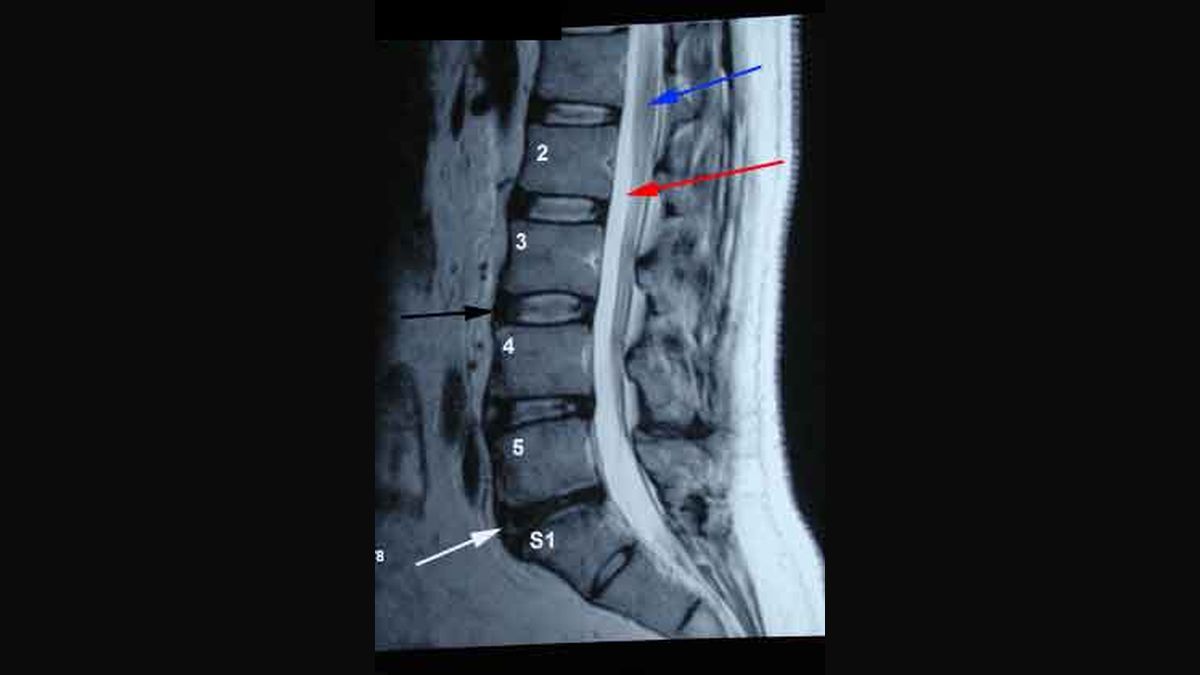
You finally got your MRI report, and it is full of words like "disc bulge," "degenerative disc disease," "desiccation" and "annular fissure." It is easy to read that list and assume your spine is falling apart and surgery is around the corner. In most cases, neither is true. Here is what these terms mean and why spine specialists look at much more than the report.
What the common terms mean
- Disc degeneration / desiccation: The discs between your vertebrae lose water and height over time, much like hair turns gray. On MRI, a dried-out disc looks darker.
- Disc bulge: The edge of the disc extends a little beyond the bone around its rim, usually broadly and evenly. It is a description of shape, not a diagnosis of injury.
- Protrusion / extrusion (herniation): A more focal piece of disc material pushes out further. Depending on where it goes, it may or may not press on a nerve.
- Annular fissure (sometimes called a "tear"): A crack in the outer ring of the disc. Despite the word "tear," it is often an age-related change.
- Facet arthropathy: Arthritis in the small joints at the back of the spine.
These words describe what the images look like. They do not, on their own, tell you what is causing your pain.
What the research shows
The best-known evidence on this question is a 2015 systematic review in the American Journal of Neuroradiology, led by researchers at Mayo Clinic. They pooled 33 studies of spine imaging in 3,110 people who had no back pain at all. The findings were striking:
- Disc degeneration was seen in 37% of 20-year-olds without pain, rising to 96% of 80-year-olds.
- Disc bulges were seen in 30% of pain-free 20-year-olds, rising to 84% of 80-year-olds.
- Disc protrusions were seen in 29% of pain-free 20-year-olds and 43% of 80-year-olds.
- Annular fissures were seen in 19% of pain-free 20-year-olds and 29% of 80-year-olds.
The authors concluded that many of these features are likely part of normal aging and not linked to pain, and that imaging findings must be interpreted in the context of the patient's clinical condition.
That does not mean MRI findings never matter. A companion meta-analysis by the same research group, also published in 2015, compared adults 50 or younger with and without low back pain. Some findings, including disc bulges, disc degeneration, extrusions, protrusions and certain bone-marrow changes next to the disc (called Modic type 1), were more common in people with back pain. In other words, these findings can be relevant, but because they also show up in many people without pain, they cannot be read in isolation.
Why the full picture matters
A spine specialist asks a simple question: do the images match the person? For example:
- A disc herniation on the left side that presses on the nerve going to the left leg, in a patient with sciatica down the left leg, is a meaningful match.
- A mild bulge at a level that does not fit the pattern of symptoms may be an incidental finding.
- Several levels of degeneration in a 60-year-old may simply reflect normal aging.
Your symptoms, the location of pain, numbness or weakness, and a physical exam all have to line up with what the MRI shows before a finding is called the cause.
Most people do not need surgery
Most back and neck pain, and most disc herniations, improve with time and non-surgical care such as activity changes, physical therapy, medications or injections. Surgery is generally considered when there is a clear match between symptoms and imaging and non-surgical care has not worked, or when there are warning signs.
Some symptoms should never wait for an MRI review: new loss of bladder or bowel control, numbness in the groin area, or rapidly worsening leg weakness. Call 911 or go to the nearest emergency room. See our page on red flags.
What this means for you
- Words like "bulge" and "degeneration" are very common on MRIs, including in people with no pain.
- An MRI report describes images; it is not a diagnosis or a treatment plan.
- What matters is whether the findings match your symptoms and exam.
- Most people with these findings never need surgery.
Get your MRI explained in plain language
If your report left you with more questions than answers, you do not have to guess. If you are in California, send your MRI report or images for a free MRI review. Dr. Hannani, a fellowship-trained orthopedic spine surgeon, looks at what you send and goes over it with you in a complimentary video visit. Learn the different ways of sending your MRI.
This article is for general education and is not medical advice.
Related procedures & care
Information is general and not a substitute for medical advice.