Artificial Disc Replacement in Los Angeles
A motion-preserving alternative to spinal fusion for the right cervical and lumbar disc patients..
;
Artificial Disc Replacement
Artificial disc replacement (ADR) is one of the most significant advances in spine surgery of the last two decades. For carefully selected patients in Los Angeles dealing with chronic neck or low back pain from degenerative disc disease, an artificial disc can relieve the pain that is grinding down their daily life without permanently locking the spine the way a traditional fusion does. Dr. Kambiz Hannani is a board-certified spine surgeon who has performed both cervical and lumbar disc replacement procedures for patients across Los Angeles County for more than two decades.
What is Artificial Disc Replacement?
Between every two vertebrae in your spine sits a disc — a soft, shock-absorbing cushion that lets your spine bend, twist, and absorb load. When a disc wears out, dries out, or herniates, the result is often pain, nerve compression, weakness, and stiffness. The traditional surgical answer has been spinal fusion: remove the bad disc and bolt the two vertebrae together so they move as one. Fusion works, but it eliminates motion at that level, which can place extra stress on the levels above and below over the following years.
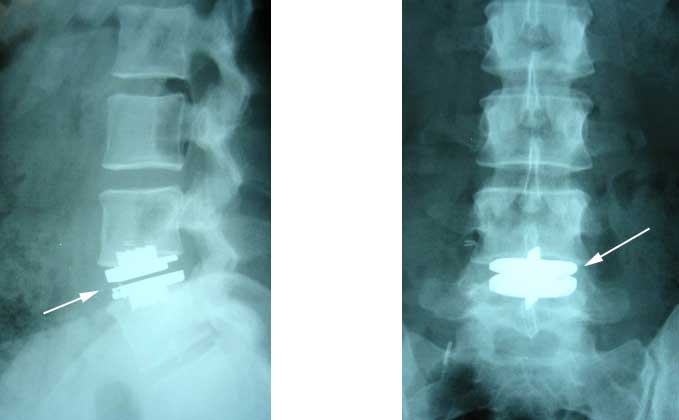
Artificial disc replacement is the alternative. The damaged disc is removed and replaced with an FDA-approved mechanical implant — typically a metal-and-polyethylene device — that preserves the natural motion of the spine. The patient keeps the ability to bend and rotate at that level, and the surrounding discs are spared the extra wear-and-tear they would absorb after a fusion.
ADR vs. Spinal Fusion: The Real Difference
For the right patient, ADR offers meaningful advantages over fusion:
Motion is preserved. The treated level still bends and rotates, which feels more natural and reduces the risk of adjacent segment disease — the long-term breakdown of the discs above and below a fusion.
Faster return to normal activity. There is no waiting for bones to fuse together. Many patients are walking the same day and back to desk work within 2 to 4 weeks.
No bone graft harvest. Fusion often requires harvesting bone from the hip; ADR does not.
Lower long-term re-operation risk at adjacent levels. Multiple long-term studies (5 and 10 years) now show ADR patients are less likely to need a second surgery at a neighboring disc compared with fusion patients.
Fusion still has its place — particularly for patients with significant instability, prior failed surgery, or severe arthritis at the facet joints. The right operation is the one that fits your spine, and that determination requires a careful in-person evaluation with imaging.
Cervical (Neck) vs. Lumbar (Low Back) Disc Replacement
Cervical disc replacement is the more common of the two procedures. It is most often used for patients with arm pain, numbness, or weakness from a herniated or degenerated cervical disc that has not improved with non-surgical care. The procedure is done through a small incision in the front of the neck (anterior approach), the diseased disc is removed, and the artificial disc is implanted in its place. Most patients go home the same day or after one night in the hospital.
Lumbar disc replacement is reserved for a narrower group — typically younger patients with isolated single-level degenerative disc disease in the low back, no significant facet arthritis, and no prior fusion. The lumbar implant is placed through an anterior approach (through the abdomen), which avoids cutting through back muscles and tends to result in less post-operative back pain than a posterior fusion.
Who is a Candidate for Artificial Disc Replacement?
Not every patient with disc pain is a candidate for ADR. The best candidates generally:
Have pain originating from a single damaged disc (or two adjacent discs)
Have failed at least 6 weeks of non-surgical treatment (physical therapy, medications, injections)
Do not have severe arthritis at the small joints behind the disc (facet joints)
Do not have significant osteoporosis
Have not had a prior fusion at the same level
Are typically between 18 and 60 years old, though older healthy patients can sometimes qualify
A thorough work-up — including current MRI, dynamic X-rays, and a physical examination — is the only way to know for sure. Patients who are not ADR candidates are not stuck: there are excellent fusion, decompression, and minimally invasive endoscopic options available.
What Recovery Looks Like
Cervical ADR patients are usually walking the same day, eating dinner that night, and home within 24 hours. Most are off narcotic pain medication within a week, driving within 2 weeks, and back to a desk job within 2 to 4 weeks. Heavy labor and contact sports are restricted for about 3 months.
Lumbar ADR recovery is slightly longer because of the abdominal approach. Patients typically stay 1 to 2 nights in the hospital, walk the next morning, and return to light activity in 4 to 6 weeks.
Why Patients Across Los Angeles Choose Dr. Hannani
Dr. Kambiz Hannani is a board-certified spine surgeon with more than two decades of experience and surgical privileges at hospitals serving Los Angeles County, including Emanate Health and previously St. John's Medical Center in Santa Monica. He completed his orthopedic surgery training at UCLA, one of the country's leading medical centers. His practice is based in West Covina with patients traveling from across Los Angeles County — including Pasadena, Glendora, Arcadia, Covina, Diamond Bar, Walnut, the San Gabriel Valley, the Westside, and Downtown LA — for second opinions, motion-preserving spine surgery, and minimally invasive options.
If you are weighing fusion against an artificial disc, the most important step is a careful, unhurried second opinion. Many patients told they need a fusion turn out to be excellent ADR or endoscopic candidates.
Frequently Asked Questions
How long do artificial discs last? Modern FDA-approved cervical and lumbar discs have published 7- and 10-year follow-up data showing excellent durability. The implants are designed to last decades.
Will my insurance cover artificial disc replacement? Cervical disc replacement is now covered by most major insurance plans in California, including Medicare, when medical necessity is documented. Lumbar disc replacement coverage varies by plan and is reviewed case-by-case. Our office handles pre-authorization on your behalf.
Can both cervical and lumbar discs be replaced? Yes — though not usually in the same operation. Some patients have both procedures done in stages.
Will I set off airport metal detectors? Generally no. The implants are small enough that most patients pass through security without an issue.
How do I schedule a consultation? Call our office at 626-939-5900 or visit our contact page. Bring any prior MRI or X-ray imaging on disc if you have it — this lets Dr. Hannani give you a meaningful opinion at the first visit.