Artificial Disc Replacement for Glendale, CA Patients
A motion-preserving alternative to spinal fusion for Glendale and Verdugo-area patients..
;
Artificial Disc Replacement
Glendale patients dealing with chronic neck or low back pain have plenty of nearby spine surgeons — Adventist Health Glendale, Glendale Memorial, and USC Verdugo Hills are all within a few minutes of The Americana at Brand. But quality, not proximity, is what determines outcomes when you are deciding whether to permanently fuse two vertebrae together. Dr. Kambiz Hannani's office sits about 25 miles east of Glendale — a 30 to 40 minute drive on the 134 East to the 210 East — and he has spent more than two decades performing both cervical and lumbar artificial disc replacement (ADR) for patients across Los Angeles County.
Dr. Hannani does not currently hold privileges at any of the Glendale hospitals. Glendale patients who choose him as their surgeon have their consultations and in-office care at the West Covina office, and surgery itself is performed either at Saint John's Medical Center in Santa Monica (about 30 minutes west of Glendale via the 134 to the 405) or, for outpatient procedures, at the Advanced Surgical Center of Beverly Hills (about 25 minutes south via the 134 to the 101). It is a more spread-out arrangement than driving five minutes to Adventist Health, and we will not pretend otherwise. What you get in exchange is an experienced ADR surgeon and OR teams that have done these procedures together for years.
Many Glendale patients arrive at our office already carrying an MRI on disc and a fusion recommendation from somewhere else. Some turn out to be excellent ADR candidates and leave with a different surgical plan. Others turn out to need the fusion after all — and they leave understanding exactly why, with the full reasoning explained. The point of the visit is honest assessment, not a sales pitch.
What is Artificial Disc Replacement?
Between every two vertebrae in your spine sits a disc — a soft, shock-absorbing cushion that lets your spine bend, twist, and absorb load. When a disc wears out, dries out, or herniates, the result is often pain, nerve compression, weakness, and stiffness. The traditional surgical answer has been spinal fusion: remove the bad disc and bolt the two vertebrae together so they move as one. Fusion works, but it eliminates motion at that level, which can place extra stress on the levels above and below over the following years.
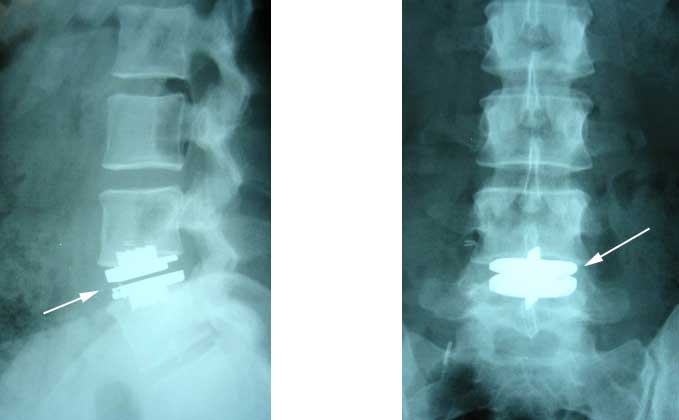
Artificial disc replacement is the alternative. The damaged disc is removed and replaced with an FDA-approved mechanical implant — typically a metal-and-polyethylene device — that preserves the natural motion of the spine. The patient keeps the ability to bend and rotate at that level, and the surrounding discs are spared the extra wear-and-tear they would otherwise absorb after a fusion.
ADR vs. Spinal Fusion: The Real Difference
For the right patient, ADR offers meaningful advantages over fusion:
Motion is preserved. The treated level still bends and rotates, which feels more natural and reduces the risk of adjacent segment disease — the long-term breakdown of the discs above and below a fusion.
Faster return to normal activity. There is no waiting for bones to fuse. Many patients are walking the same day and back to desk work within 2 to 4 weeks.
No bone graft harvest. Fusion often requires harvesting bone from the hip; ADR does not.
Lower long-term re-operation risk at adjacent levels. Multiple long-term studies (5 and 10 years) now show ADR patients are less likely to need a second surgery at a neighboring disc compared with fusion patients.
Fusion still has its place — particularly for patients with significant instability, prior failed surgery, or severe arthritis at the facet joints. The right operation is the one that fits your spine, and that determination requires a careful in-person evaluation with imaging.
Cervical (Neck) vs. Lumbar (Low Back) Disc Replacement
Cervical disc replacement is the more common of the two procedures. It is most often used for patients with arm pain, numbness, or weakness from a herniated or degenerated cervical disc that has not improved with non-surgical care. The procedure is done through a small incision at the front of the neck (anterior approach), the diseased disc is removed, and the artificial disc is implanted in its place. Most patients go home the same day or after one night in the hospital.
Lumbar disc replacement is reserved for a narrower group — typically younger patients with isolated single-level degenerative disc disease in the low back, no significant facet arthritis, and no prior fusion. The lumbar implant is placed through an anterior approach (through the abdomen), which avoids cutting through back muscles and tends to result in less post-operative back pain than a posterior fusion.
Why Glendale Patients Choose Dr. Hannani for Disc Replacement
Glendale has a strong word-of-mouth medical culture. In a community where multiple generations often share the same primary care doctor and where reputation travels fast through family and church networks, patients tend to seek out surgeons known for careful judgment rather than aggressive marketing. Dr. Hannani is board-certified in orthopedic surgery, completed his residency at UCLA, did his spine fellowship at Saint John's in Santa Monica, and has been performing both cervical and lumbar ADR for over 20 years. His consultations are unhurried for exactly the kind of patient who wants to understand what is being recommended and why — and who often plans to bring a spouse, adult child, or parent into the conversation before deciding.
There is also a practical advantage to Dr. Hannani's setup for Glendale residents: surgical options on either side. If west is more convenient on surgery day — perhaps because family is in Santa Monica or because the patient prefers the Westside hospital environment — Saint John's is the primary surgical home. If outpatient is appropriate for the procedure, Advanced Surgical Center of Beverly Hills is closer to Glendale than driving back east. The right facility depends on the operation and the patient, and we work that out at the consultation.
Where Surgery is Performed for Glendale Patients
Dr. Hannani does not have privileges at Adventist Health Glendale, Glendale Memorial, or USC Verdugo Hills. For Glendale patients, ADR surgery is performed at one of these locations:
Saint John's Medical Center, Santa Monica — Dr. Hannani's primary inpatient surgical location. About 30 minutes west of Glendale via the 134 to the 405. Where most cervical and lumbar ADR cases are performed.
Advanced Surgical Center of Beverly Hills — about 25 minutes south of Glendale via the 134 to the 101. Used for selected outpatient cervical disc replacement cases when overnight admission is not required.
Initial consultation and follow-up: West Covina office, about 30 to 40 minutes east of Glendale via the 134 to the 210. Free on-site parking — no garage hunting.
A Patient Story
A 51-year-old graphic designer from Adams Hill came in last year with eight months of left arm pain, numbness in her thumb and index finger, and a C5-C6 disc herniation on MRI. She had already been told by another surgeon — at a hospital closer to her home — that she needed a two-level cervical fusion. On review of her actual imaging, the C6-C7 level above looked degenerated but was not the source of her symptoms, and her C5-C6 disc still had good height with no facet arthritis. She underwent a single-level cervical disc replacement at Saint John's in Santa Monica, went home the next morning, was off narcotics within five days, and was back at her drafting tablet within three weeks. The drive home from Santa Monica that morning, she later told us, was easier than the parking situation at most LA hospitals.
Who is a Candidate for Artificial Disc Replacement?
Not every patient with disc pain is a candidate for ADR. The best candidates generally:
Have pain originating from a single damaged disc (or two adjacent discs)
Have failed at least 6 weeks of non-surgical treatment (physical therapy, medications, injections)
Do not have severe arthritis at the facet joints
Do not have significant osteoporosis
Have not had a prior fusion at the same level
Are typically between 18 and 60 years old, though older healthy patients can sometimes qualify
A thorough work-up — including current MRI, dynamic X-rays, and a physical examination — is the only way to know for sure. Patients who are not ADR candidates are not stuck: there are excellent fusion, decompression, and minimally invasive endoscopic options available.
What Recovery Looks Like
Cervical ADR patients are usually walking the same day, eating dinner that night, and home within 24 hours. Most are off narcotic pain medication within a week, driving within 2 weeks, and back to a desk job within 2 to 4 weeks. Heavy labor and contact sports are restricted for about 3 months.
Lumbar ADR recovery is slightly longer because of the abdominal approach. Patients typically stay 1 to 2 nights in the hospital, walk the next morning, and return to light activity in 4 to 6 weeks.
Frequently Asked Questions from Glendale Patients
How far is the drive from Glendale to your West Covina office? Typically 30 to 40 minutes, depending on traffic and where in Glendale you are starting from. The simplest route is the 134 East to the 210 East, exiting at one of the West Covina exits. From Northwest Glendale, La Crescenta, or Montrose, count on the higher end of that range. Free on-site patient parking, so no garage hunting.
Where will my surgery be performed? Can it be done at Adventist Health Glendale or Glendale Memorial? No — Dr. Hannani does not currently hold surgical privileges at the Glendale hospitals (Adventist Health Glendale, Glendale Memorial, or USC Verdugo Hills). Cervical and lumbar ADR are typically performed at Saint John's Medical Center in Santa Monica, about 30 minutes west of Glendale via the 134 to the 405. Selected outpatient cases can be done at Advanced Surgical Center of Beverly Hills, about 25 minutes south.
Do you have a Glendale location? No. Dr. Hannani's office is in West Covina, about 30 to 40 minutes east of Glendale. Surgical locations are Saint John's in Santa Monica (west) and Advanced Surgical Center of Beverly Hills (south). We are upfront about this — many Glendale patients still choose to make the drive because of the experience and second-opinion value, but if proximity is your top priority, you have closer options in Glendale itself.
I was told I need a two-level fusion. Could that ever be a disc replacement instead? Sometimes. Two-level cervical disc replacement is FDA-approved and is the right operation for selected patients. Two-level lumbar ADR is more limited. The only way to know is a careful imaging review — bring your MRI on disc to the consultation.
How do I schedule a consultation? Call our office at 626-939-5900 or visit our contact page. Bring any prior MRI or X-ray imaging on disc if you have it — this lets Dr. Hannani give you a meaningful opinion at the first visit.