Artificial Disc Replacement in Covina
A motion-preserving alternative to spinal fusion for the right cervical and lumbar disc patients..
;
Artificial Disc Replacement
If you live in Covina and you have been told you may need spine surgery, the good news is that one of the region's most experienced motion-preserving spine surgeons works just down the road — and operates at the hospital you probably already know. Dr. Kambiz Hannani's office in West Covina sits about three miles west of downtown Covina, a 5 to 10 minute drive on local streets like Garvey, Badillo, or Citrus Avenue. His primary surgical home is Emanate Health Inter-Community Hospital, right in the heart of Covina. For Covina residents weighing artificial disc replacement against a traditional fusion, that proximity matters more than most patients realize: it means familiar surroundings, a short ride home after surgery, and a surgeon who has cared for multiple generations of families in this community.
Artificial disc replacement (ADR) is one of the most significant advances in spine surgery of the last two decades. For carefully selected patients with chronic neck or low back pain from degenerative disc disease, an artificial disc can relieve the pain that is grinding down their daily life without permanently locking the spine the way a traditional fusion does. Dr. Hannani is a board-certified spine surgeon who has performed both cervical and lumbar disc replacement procedures for patients across the San Gabriel Valley — and Covina specifically — for more than two decades.
Many of the Covina patients we see have already been told by another surgeon that they need a fusion. A real second opinion from a surgeon who actually performs both fusion and ADR is often the most important step in your spine care.
What is Artificial Disc Replacement?
Between every two vertebrae in your spine sits a disc — a soft, shock-absorbing cushion that lets your spine bend, twist, and absorb load. When a disc wears out, dries out, or herniates, the result is often pain, nerve compression, weakness, and stiffness. The traditional surgical answer has been spinal fusion: remove the bad disc and bolt the two vertebrae together so they move as one. Fusion works, but it eliminates motion at that level, which can place extra stress on the levels above and below over the following years.
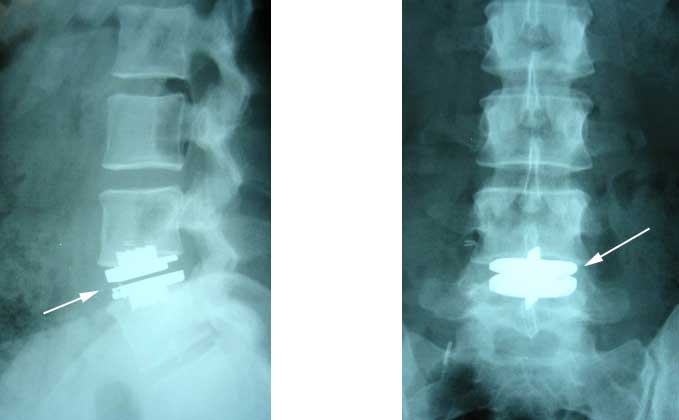
Artificial disc replacement is the alternative. The damaged disc is removed and replaced with an FDA-approved mechanical implant — typically a metal-and-polyethylene device — that preserves the natural motion of the spine. The patient keeps the ability to bend and rotate at that level, and the surrounding discs are spared the extra wear-and-tear they would absorb after a fusion.
ADR vs. Spinal Fusion: The Real Difference
For the right patient, ADR offers meaningful advantages over fusion:
Motion is preserved. The treated level still bends and rotates, which feels more natural and reduces the risk of adjacent segment disease — the long-term breakdown of the discs above and below a fusion.
Faster return to normal activity. There is no waiting for bones to fuse together. Many patients are walking the same day and back to desk work within 2 to 4 weeks.
No bone graft harvest. Fusion often requires harvesting bone from the hip; ADR does not.
Lower long-term re-operation risk at adjacent levels. Multiple long-term studies (5 and 10 years) now show ADR patients are less likely to need a second surgery at a neighboring disc compared with fusion patients.
Fusion still has its place — particularly for patients with significant instability, prior failed surgery, or severe arthritis at the facet joints. The right operation is the one that fits your spine, and that determination requires a careful in-person evaluation with imaging.
Why Patients in Covina Choose Dr. Hannani for Disc Replacement
For Covina residents, the decision to have spine surgery is rarely just about the procedure — it is also about who is doing it, where, and how easily a spouse, son, or daughter can get to the hospital to be there. Dr. Hannani is the local spine surgeon for this community. His West Covina office is roughly three miles from downtown Covina, and his primary surgical hospital — Emanate Health Inter-Community Hospital — is right inside the city. That means the OR team, anesthesiologists, and post-op nurses caring for you on surgery day are people Dr. Hannani works with regularly, not a rotating cast at a faraway downtown LA hospital.
Many of our Covina patients are second- or third-generation residents whose parents or in-laws were also under Dr. Hannani's care. There is real value in having a spine specialist who lives and works in your own community — one who knows the local primary care doctors, the nearby physical therapy clinics, and the orthopedists you may have already seen. There is no reason to fight the 10 freeway into Westside or downtown traffic when the same caliber of motion-preserving spine care is available a few minutes from your driveway.
Cervical (Neck) vs. Lumbar (Low Back) Disc Replacement
Cervical disc replacement is the more common of the two procedures. It is most often used for patients with arm pain, numbness, or weakness from a herniated or degenerated cervical disc that has not improved with non-surgical care. The procedure is done through a small incision in the front of the neck (anterior approach), the diseased disc is removed, and the artificial disc is implanted in its place. Most patients go home the same day or after one night in the hospital.
Lumbar disc replacement is reserved for a narrower group — typically younger patients with isolated single-level degenerative disc disease in the low back, no significant facet arthritis, and no prior fusion. The lumbar implant is placed through an anterior approach (through the abdomen), which avoids cutting through back muscles and tends to result in less post-operative back pain than a posterior fusion.
Getting to Our Office from Covina
Our West Covina office is about 3 miles from downtown Covina — a 5 to 10 minute drive depending on time of day. Most Covina patients take Garvey Avenue, Badillo Street, or Citrus Avenue south and west; the 10 and 210 freeways are also close options. Free patient parking is available directly at the building, and the front entrance is a short, level walk from the lot — easy for patients who are already dealing with back or neck pain.
A Covina Patient Story
A longtime Covina resident in her early 50s came in after two years of worsening neck and right arm pain that had begun interfering with her work as a nurse. Her MRI showed a single-level cervical disc herniation. Another surgeon had already recommended a two-level fusion. After review, she turned out to be an excellent candidate for a single-level cervical disc replacement instead. The procedure was performed at Emanate Health, she went home the same evening, was off narcotics within a week, and returned to her hospital floor on light duty at three weeks. She kept the natural motion in her neck — and avoided locking down a second level she did not actually need fused.
Who is a Candidate for Artificial Disc Replacement?
Not every patient with disc pain is a candidate for ADR. The best candidates generally:
Have pain originating from a single damaged disc (or two adjacent discs)
Have failed at least 6 weeks of non-surgical treatment (physical therapy, medications, injections)
Do not have severe arthritis at the small joints behind the disc (facet joints)
Do not have significant osteoporosis
Have not had a prior fusion at the same level
Are typically between 18 and 60 years old, though older healthy patients can sometimes qualify
A thorough work-up — including current MRI, dynamic X-rays, and a physical examination — is the only way to know for sure. Patients who are not ADR candidates are not stuck: there are excellent fusion, decompression, and minimally invasive endoscopic options available.
What Recovery Looks Like
Cervical ADR patients are usually walking the same day, eating dinner that night, and home within 24 hours. Most are off narcotic pain medication within a week, driving within 2 weeks, and back to a desk job within 2 to 4 weeks. Heavy labor and contact sports are restricted for about 3 months. For Covina patients, the short drive home from Emanate Health after discharge is one less stress to worry about.
Lumbar ADR recovery is slightly longer because of the abdominal approach. Patients typically stay 1 to 2 nights in the hospital, walk the next morning, and return to light activity in 4 to 6 weeks.
Frequently Asked Questions from Covina Patients
Where do you perform surgery? Dr. Hannani performs the majority of his procedures at Emanate Health Inter-Community Hospital, right in Covina. Select cases are also performed at nearby outpatient surgery centers in the San Gabriel Valley. Either way, you are not driving into downtown LA on surgery day.
How quickly can I get an appointment if I live in Covina? New patient consultations are typically available within 1 to 2 weeks. Urgent cases — significant weakness, loss of bowel or bladder control, severe escalating pain — are seen sooner, often within 24 to 48 hours. Call 626-939-5900 and tell our front desk you are local.
Do you take Covina-area insurance plans and Medi-Cal? We accept most major commercial insurance plans used in the Covina area, including PPO and many HMO products, plus Medicare. Medi-Cal participation depends on your specific managed care plan — call our office and we will verify on your behalf before your visit.
How long do artificial discs last? Modern FDA-approved cervical and lumbar discs have published 7- and 10-year follow-up data showing excellent durability. The implants are designed to last decades.
How do I schedule a consultation? Call our office at 626-939-5900 or visit our contact page. Bring any prior MRI or X-ray imaging on disc if you have it — this lets Dr. Hannani give you a meaningful opinion at the first visit.